Odoo Implementation Guide: A Complete Roadmap for Successful ERP Deployment
Implementations of an ERP system are also a major step towards operational efficiency and business scalability. Among modern ERP solutions, Odoo stands out for its flexibility, modular architecture, and ability to adapt to all kinds of businesses of all kinds of sizes. However, the success of Odoo depends not just on the software itself, but on how well it is implemented. This Odoo implementation guide walks you through the essential stages of deploying Odoo effectively, ensuring maximum ROI and long-term success with the right kind of implementations partner- O2B technologies.
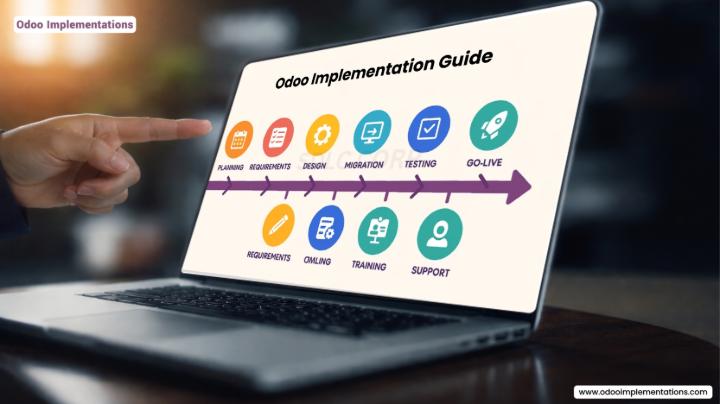
What is Odoo Implementation?
Odoo implementation is the structured process of configuring, customizing, and deploying Odoo ERP to align with a business’s workflows, goals, and all industry requirements. It also involves planning, module selections, data migrations, integrations, testing, training, and post-go-live support.
A well-planned implementation ensures that Odoo works as a unified system rather than a collection of all kinds of disconnected modules.
Step 1: Business Requirement Analysis
The foundations of a successful Odoo implementation start with a proper kind of understanding of your business processes in depth. This phase also focuses on identifying:
Current workflows and all the operational gaps
Business goals and growth plans
Required Odoo modules and custom features
Integrations need to work with third-party systems
At O2B Technologies, our consultant works closely with the stakeholders to map real business needs to Odoo’s capabilities and ensure no unnecessary complexity is introduced.
Step 2: Odoo module selections & solutions design
Odoo also offers a wide range of modules covering sales, CRM, inventory, manufacturing, accounting, HR, project management, and many more. Selecting the right combinations of the modules is very crucial.
During this phase:
Core and advanced modules are finalized
System architecture is designed
Customization requirements are also documented
Future scalability is also considered
O2B technologies also ensure that your Odoo setup is very scalable, efficient, and even aligned with all kinds of long-term business objectives.
Step 3: Customizations & configuration
While Odoo is also powerful out of the box, most businesses require customizations to even match all kinds of workflows. This step also included:
Configuring workflows, roles, and permissions
Customizing reports and dashboards
Developing custom modules or features
Enhancing UI/UX for better usability
O2B technologies follows Odoo best practices to deliver clean, upgrade-safe customizations without compromising system performance.
Step 4: Data migration
Accurate data migrations are one of the most critical phases of Odoo implementations. This also involves transferring data from legacy systems such as spreadsheets, accounting tools, or even older ERPs into Odoo.
Some of the key data includes:
Customers and vendors
Products and pricing
Accounting records
Inventory and historical transactions
O2B technologies ensure data accuracy, validation, and consistency to even avoid operational disruptions after go-live.
Step 5: Third-party integrations
Modern businesses rely on multiple systems such as payment gateways, shipping providers, marketplaces, CRMs, and BI tools. Odoo’s open architecture allows seamless kinds of integrations with third-party applications.
O2B technologies specializes in:
Payment gateway integrations
Shipping and logistics integrations
E-commerce platform integrations
External accounting and reporting tools
This also ensures Odoo functions as a central operations hub rather than an isolated system.
Step 6: Testing & quality assurance
Before deployment, rigorous testing is essential to ensure system stability and accuracy. This also includes:
Functional testing of workflows
User acceptance testing (UAT)
Performance and security testing
Edge-case scenario validation
O2B technologies conducts comprehensive testing to ensure the systems perform reliably under real business conditions.
Step 7: User training & go-live
Even the best ERP systems also fail without user adoption. The proper kinds of training also empower teams to use Odoo confidently and efficiently.
This phase includes:
Role-based user training
Documentations and user guides
Go live planning and execution
Live system monitoring
O2B technologies ensure a smooth transition with minimal downtime and maximum user confidence.
Step 8: Post-implementation support & optimizations
Odoo implementations don't end at go-live. Continuous support and optimizations are vital as business needs evolve.
Post-implementation services include:
Bug fixes and performance tuning
Feature enhancements
Odoo version upgrades
Ongoing consulting and support
O2B technologies acts as a long-term ERP partner, ensuring your Odoo system grows with your business.
Why choose O2B technologies for Odoo implementation?
O2B technologies brings deep kinds of Odoo expertise, industry experiences, and a structured implementation approach. Our teams focus on delivering solutions, not just technical setups. From startups to enterprises, we also help organizations unlock the full potential of Odoo with tailored, scalable, and future-ready implementations.
Conclusions
A successful ERP journey starts with the right implementation strategy. By following a structured Odoo implementation guide and partnering with an experienced provider like O2B Technologies, businesses can achieve operational efficiency, real-time visibility, and sustainable growth. With the right planning and execution, Odoo becomes more than software—it becomes the backbone of your business operations.